
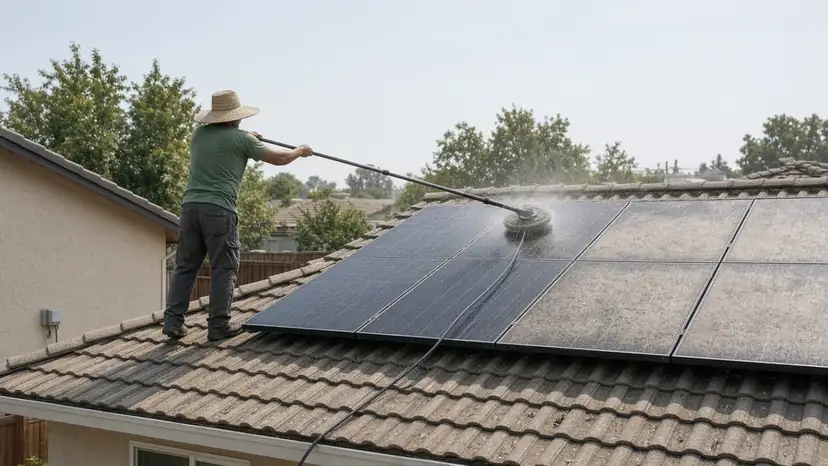
Why panels get dirty here
Panels sit outside all year and collect dust, pollen, leaves, and bird droppings. Fresno’s long dry stretch from late spring into fall means there’s little rain to rinse them off, and homes near fields, dirt roads, or trees tend to collect more.
How to tell if yours need it
- You can see a film of dust or pollen on the glass from the ground.
- There are bird droppings or leaves on the panels.
- Your monitoring app shows lower output than usual on clear, sunny days.
To judge whether a cleaning helped, compare your app’s output on similar clear days before and after. We don’t promise a percentage gain, because it depends on how dirty the panels were.
How often
There’s no single answer. A good habit is to look at your panels and your monitoring app a couple of times a year, for example after spring pollen and at the end of the dry, dusty season, and schedule a cleaning when you see buildup.
How we clean them
We use a rotating brush on a water-fed pole, with water from our RO system (Reverse Osmosis system). RO water is clean and leaves no water spots, so we don’t use soaps or chemicals. It’s gentle on the glass and frames.
If you clean your own panels, don’t climb onto the roof, and check your panel maker’s cleaning guidance first. Avoid abrasive pads, harsh soaps, and hard tap water, which can leave spots.
What it costs
It depends on the number of panels, how easy the roof is to reach, and how dirty they are. We look at the array before quoting and give you the cost before any work starts. See solar panel cleaning, or check Fresno, Clovis, and Madera.
Written by ACRE Landscape Co., Fresno & Clovis. Updated October 26, 2026.